
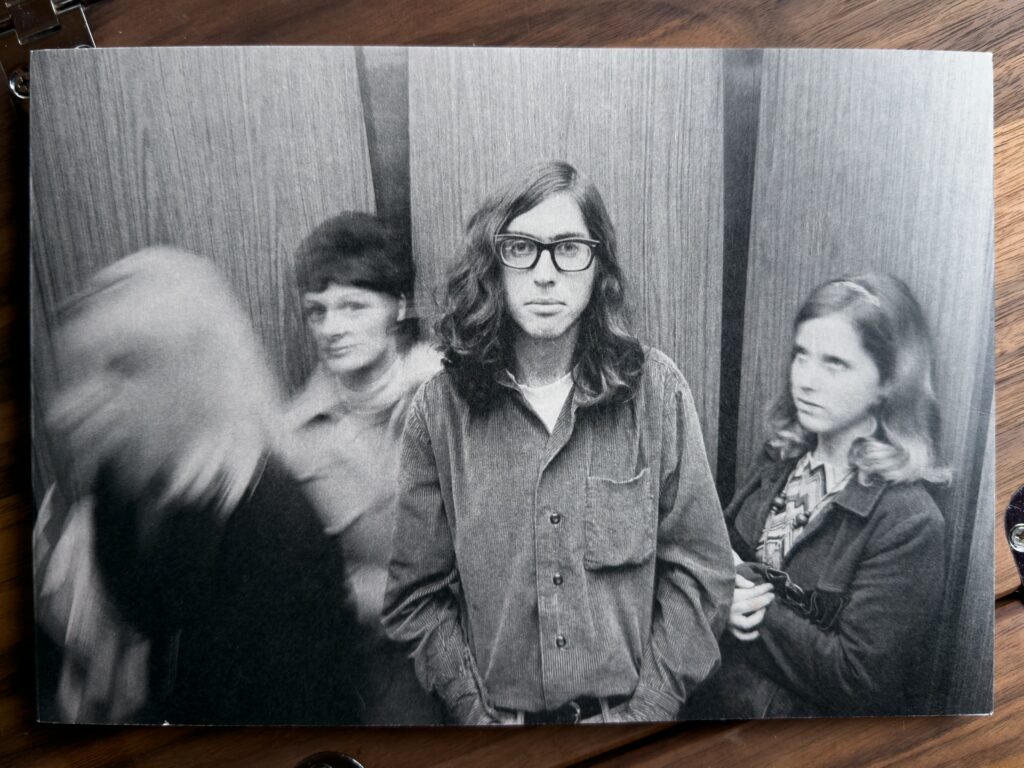
Mike Mandel doesn’t know it yet, but his new book, MYSELF: Timed Exposures, is a Turing Test.
On the cover of the book is an image of several people standing in what appears to be an elevator. There’s a blonde woman on the left, blurred nearly to indecipherability, and next to her is another woman, maybe in her 40s, back to the rear wall, only a little blurred, wearing a neck scarf, her hair in a mullet, and looking askew at the camera. On the image’s right, standing against the side wall of the elevator is a third woman, a young woman, straight brown hair, sun bleached at the ends curling upon her shoulders, facing forward but eyes gazing at the ceiling, her zig-zag, no doubt multi-colored blouse under a sensible wool jacket, her arms pressed against her, guarding her purse.
Standing in the middle of the frame, full-faced to the camera in this confined space, is some dude with brown hair as long as that of the young woman’s, parted on the side, wearing a buttoned-up corduroy shirt with a white T-shirt underneath, his hands in his pants pockets, something heavy in his shirt’s large breast pocket, his hair, tussling down in front of his shoulders, framing his long face, his posed-blank expression, his thick-framed glasses which sit a little cock-eyed.
It’s Mike Mandel. He is taking a selfie.
It’s the early 1970s, of course, and as the book goes on it is clear that Mandel is making the images mostly on or near some college campus in Southern California. Indeed, though I read very little of the text in the book (a strategy that has served me well for decades) I did note that this was a student project with its central strategy that Mandel would take his tripod-mounted Nikon, go out somewhere, find strangers, and photograph himself with the strangers. Some of the “strangers” seem to be friends or fellow students and professors, but most look to be legitimate strangers, people that he just walked up to, or just set up the camera pointing at them and then jumped into the photo, the familiar buzz of the camera’s self-timer alerting everyone (as if the tripod and the camera weren’t enough) that a photo was about to be taken.
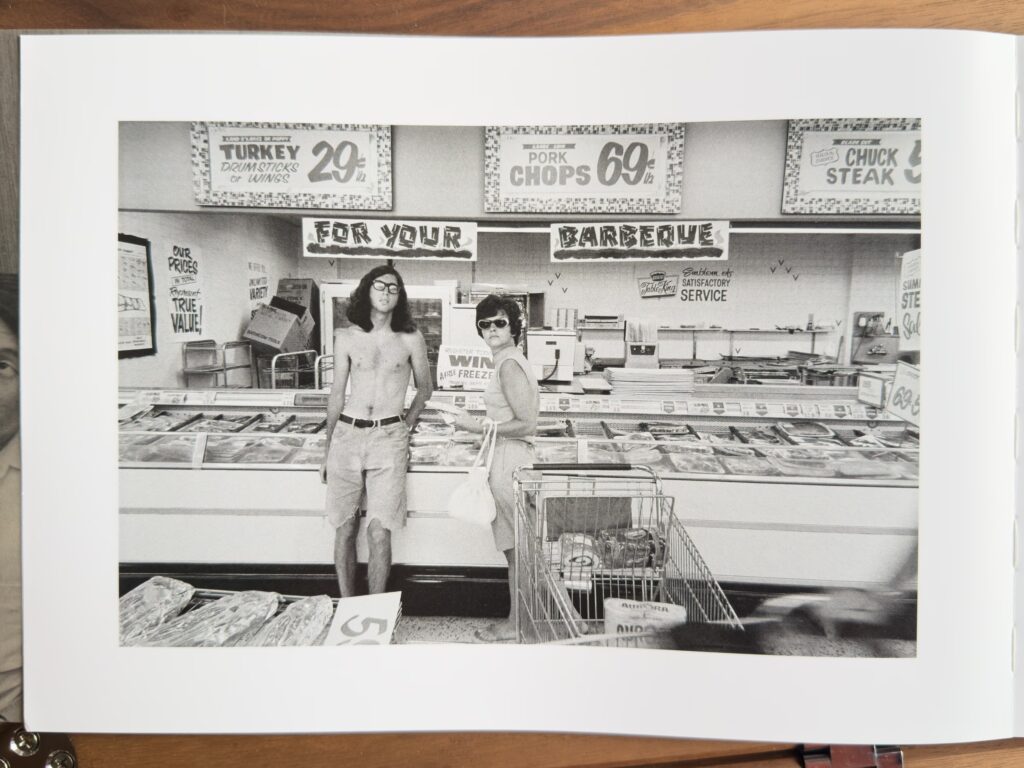
Like a Friendlander image, photography has been generous to Mandel. In the second image in the book, he is standing shirtless against a supermarket meat counter, a dark-haired woman next to him caught looking quizzically at the camera, her stylish dark sunglasses not masking her thoughts at all.
The straight-on perspective, the butcher signs all over, this is Walker Evans territory except this photo isn’t really about the butcher counter. It’s all about Mike Mandel, about the woman standing next to him, about their reactions to each other and, most of all, their reactions to the camera.
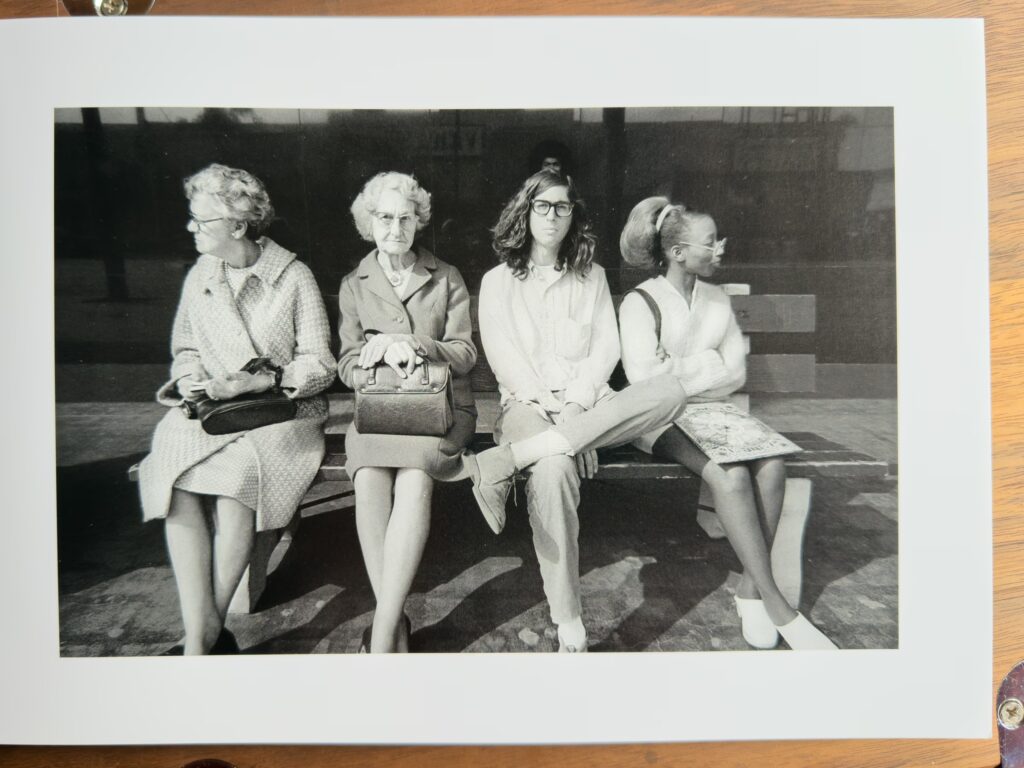
A few pages later and there is a bench, perhaps a bus stop, and Mandel has framed it up head-on. To Mandel’s right (our left) are two elderly women, formally dressed as elderly women have seemingly always dressed, each holding a black leather purse that could pass for a miniature attorney’s briefcase, one staring sternly at the camera, the other tuned away, either curious about the goings-on just down the road or perhaps wanting nothing to do with this weird man that sits next to them, nor with the camera. To Mandel’s right, an older black woman sits arms crossed in her thick white sweater, head turned in profile away from Mandel. A large, flat folder rests upon her lap, an illustration of a groovy Art Nouveau sundial of some sort filling its cover. Mandel himself sits deadpan, again, one leg crossed over the other, a white long-sleeved shirt, over a white t-shirt. Again, something heavy is in the breast pocket, something amorphous in shape. His long socks are as white as his shirt and he’s wearing tan Chukka boots, an identical pair still sold today, by Allen Edmonds, over fifty years later.
You might leap to conclusions, suggesting that the student Mike Mandel is thinking of Garry Winogrand’s famed 1964 image of a row of women on a park bench, but the vibe here is more August Sander than any “snap it as you walk along with a friend” street shooter.
Sometimes, though, photography can be a little too generous. Directly behind Mandel’s head is a small, shadowy face, looking at us, like some folkloric fiend, hugely afro’d and foreboding. I cannot unsee it.
Intermission. I’m trying to write this all in one go, as I do, trying to write my experience of the book rather than to put together some essay with some scholarly tone, trying to share my experience rather than to tell you what to think, but a whale is jumping out of the ocean not two hundred feet from me. I’m in a camper van, rear doors open to the sea, and my wife saw the whale in the air, then the splash. I see the last moment of the splash.
The whale has only just begun. For the next half hour the whale—it’s a humpback—played about in the outer surf, rolling about, its long pectorals flopping, or gliding under the water with its fin raised like some pretend Orca. Its fluke makes a sharp, nail gun-like whack when it smacks against the ocean’s surface, slightly delayed by the slow speed of sound, and the whale slapped its tail on the water again and again, over a dozen slaps at a time, three seconds apart, whether some signal to other whales, some technique to stun fish, or just for fun, I do not know. I don’t think anyone does.
There are groups of people on the beach, some on the bluffs where my wife and I soon stand. Few notice the whale, despite the report of each slap clearly audible over the repetitive crash of the surf. You almost have the urge to shout “whale!” at these moments, but even those nearby on the beach would not hear you, your voice drowned out by the waves. I look around on the bluffs, but no one is near, no one with whom to share this extraordinary scene.
Many of the people on the beach are looking at their phones anyway, stupefied.
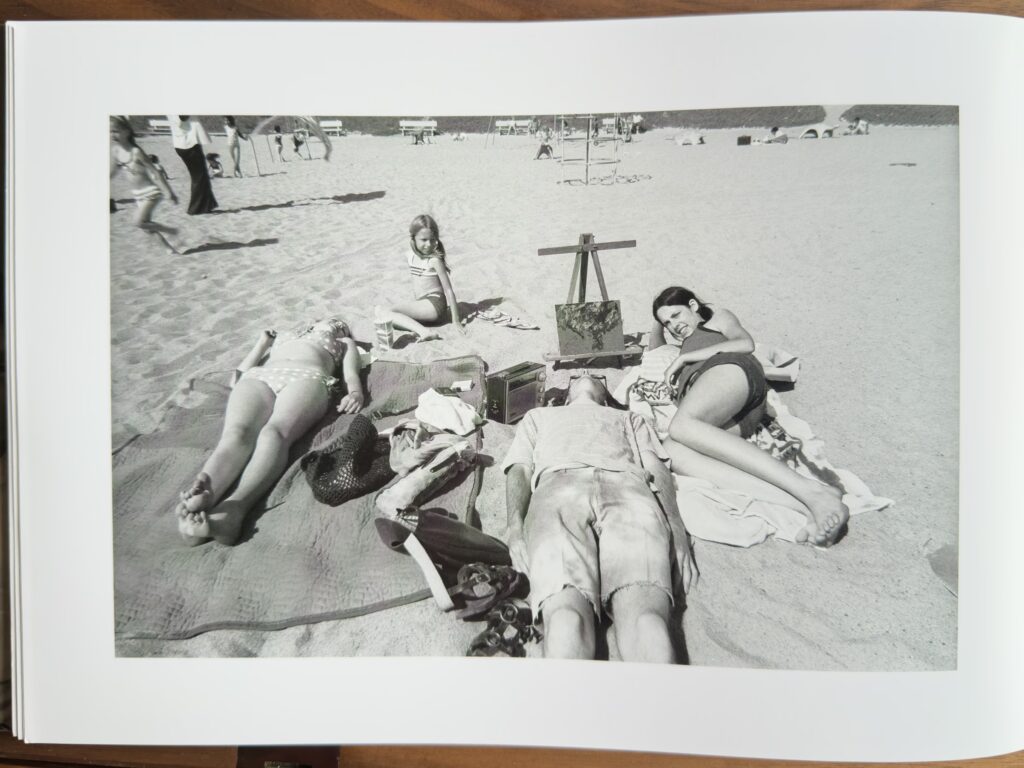
But back to the book. I open to a page at random. The image is of a beach, one of those Southern California beaches where they built at least two eighteen-story apartment buildings right up against the sand, a long straight fence demarcating the private property from the public property.
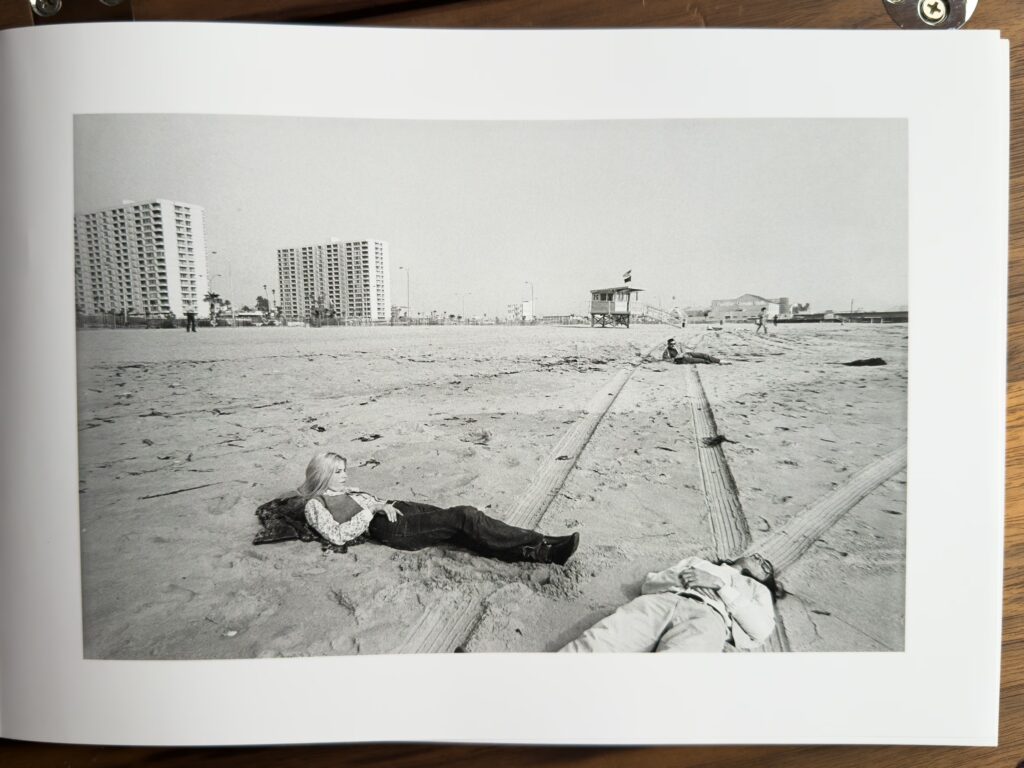
In the middle distance is a raised wooden lifeguard station, a hut with a ramp leading up to it, flags flying from its roof. Behind that a ways, at the far distance of the image, is the Pacific Ocean Park amusement park, on the Santa Monica beachfront, probably abandoned by the time this image was made, its iconic, curved, supposedly starfish-shaped entrance canopy still intact, the park loved only now perhaps by the surfers and skateboarders who made it theirs.
Directly in the foreground is a woman, lying on her back, a large, dark jacket crumpled under her upper body against the sand. Her head is raised in seeming annoyance at this guy who has just plopped himself down, four feet from her, unexpected, unwanted, and what is he doing? Right about now, you notice the woman’s clothing. Instead of a bathing suit or shorts or jeans and a shirt as you might expect, this woman is dressed head to toe in western wear. Her black boots are square-toed, her wide-bottomed dark jeans would suit any ranch hand. She wears a long-sleeved cowgirl shirt with a vest, buttoned at the top, a square silver belt buckle completing the look. As this is Southern California, she is blonde, with the straight-cut Brady Bunch/Manson family hairstyle so popular at the time. The sand next to her is disturbed from her kneeling there, from her taking off her coat and arranging it to cushion her head.
There are parallel tire tracks running through the sand in the middle of the scene, one of them passing under the woman’s lower legs and going off toward the amusement park, the other track forming an “x” as a third track comes in at an angle, with the back of Mandel’s head resting where they cross, his face slightly turned, pretending he is unaware of the woman. He’s wearing his kakis again, and his white shirts, and is he, too, wearing a vest?
There’s more going on in this image the more you observe, and you are not the only one taking it all in. Down a ways along the tire tracks is a man. He is attentive in the sand, his body crossing the same tire track that Mandel has chosen for his own, sitting up concernedly, dark glasses on, thickly mustachioed, watching everything, watching the woman, watching the tripod, and probably most of all watching Mandel.
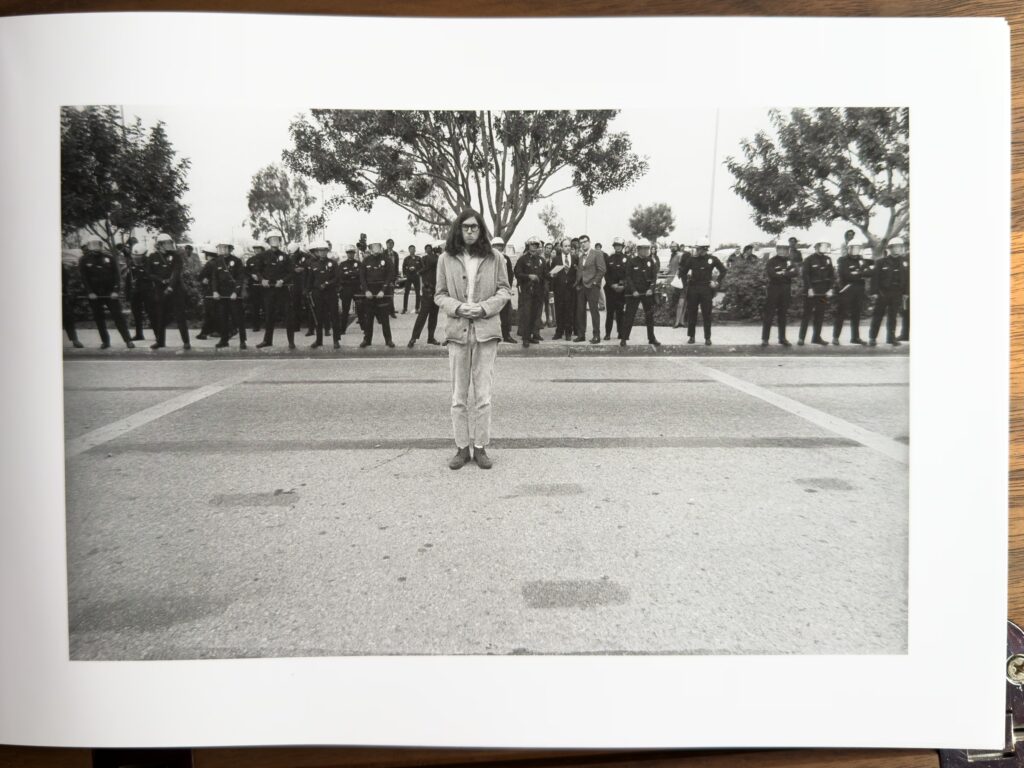
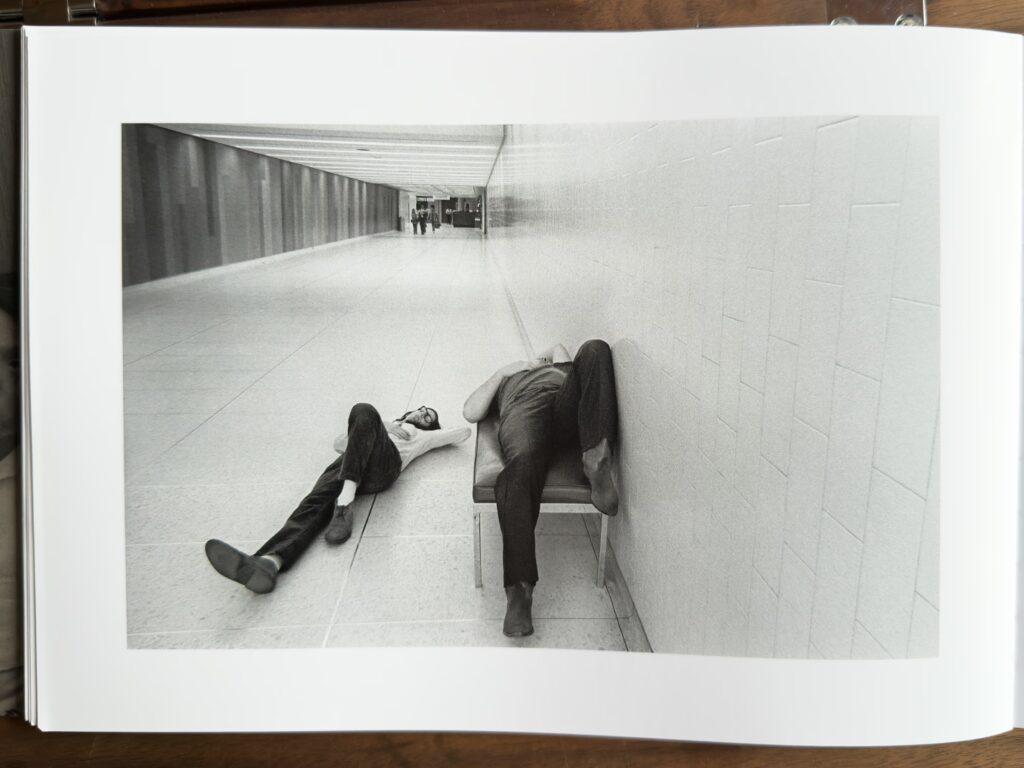
In the book Mandel is everywhere, inserting himself everywhere. He is at protests, posing with both the protesters and the cops, he is at Glacier Point in Yosemite, the ranger lecturing people off-camera. He is next to a sleeping man at an airport terminal, taking a self-portrait on a passenger plane, the people behind him, in the frame, looking at us, right at the lens, with perplexity, with doubt. There he is standing with catcher Tom Haller on the field at Dodgers Stadium, Mandel struggling to keep his face emotionless. He’s with groups of children, at beach picnics, posing with a barber in his shop. Usually Mandel tries for a deadpan expression, despite his apparent natural exuberance, but the facial expressions of the others next to him range from indifference, unawareness, indignation, and curiosity to unabashed delight.
How cool to be in a photograph, how fun to pose in front of a camera from some guy who just walked up to you. You’ll tell your friends about this moment, laugh about it, how wonderful.
These are the days of Ansel Adams workshops, when Minor White was still the editor of Aperture Magazine, when some lanky, long-faced dude in a corduroy jacket could go around, photograph all of the stars of the photography world, and make those images into baseball cards. Good god, delightful.
I don’t think you could make this project today. First of all, your school would likely not accept such a project, pushing instead for some political angle, art hopelessly confused with activism. Second, the people in the photos, the people next to you, would likely not be so thrilled with the prospect of you making images of them, suspicious of your intentions, the experience of being photographed by strangers no longer one of bemusement but one of automatic suspicion, even hostility.
The third reason that this project wouldn’t work today is because of Alan Turing. His Turing test, spelled out in 1950, was simple and profound. How can you tell if an artificial intelligence is truly intelligent, intelligent in the same way that a human is intelligent? Turing’s answer: You simply have a conversation with it. If you can’t tell that it’s an AI, then it’s intelligent. This definition worked fine for a long time, with the computer program ELIZA, made a few years before the photographs in Mandel’s book, serving as an example of the efforts of computer scientists to develop a true AI. It was a conversational bot, attempting to keep you endlessly chatting, though its limitations—its vague responses, the way it repeated your own phrases, robot-like—soon broke any illusion.
Today’s chatbots are far beyond ELIZA, convincing in their conversations, flattering, connecting the dots, suggesting new ideas with an endless energy. Ask the chatbot itself and it will assure you that it is all an illusion, that it is just a probabilistic model, sifting through the internet’s vast resources, feeding back to you a much more advanced version of what ELIZA attempted, with no “mind” or “intelligence” behind it, so no worries. But then you notice that many of the people you know and many of the people you meet speak in a way that exactly mimics the chatbot and you know now what Turing did not, that the singularity isn’t a singularity but a gradual change, the frog in the stew pot, the recent advances in AI building on the social media algorithms that went before, the 24-hour CNN news cycle even before that, this other world in our collective minds more and more divided from the real world, divided us from each other, from ourselves.
I see Mandel’s Timed Exposures as a timed machine, a scale for use to measure, to see, the gap that has formed from what was and what is now. The Turning Test, at its heart, is a way to determine what is real from what is not real, what is true from what is illusion, and Mandel’s book is a “test” of that same sort, a metric, a way to see how far we have gone, how far gone we are.
Whenever I find myself getting a little disheartened with the direction photography has taken, whenever I begin to doubt its power, I find myself reworking Edward Weston’s Pepper No. 30, most recently making images of peppers in supermarkets across the American Southwest. Timed Exposures touches on that same essence, an example of photography as photography, photographs where the act of photographing matters. Not some artist using photography (as they used to say starting with the arrival of Cindy Sherman in the early 1980s), not some trust-fund-baby photographer social media warrior, but the work of a photographer making photographs, the thing itself.
Photography has by and large lost its way, as have we all, the creeping Mordor cloud of technology leaving us increasingly cloistered, increasingly controlled. Yet here we are on the edge of yet another, deeper dive into the world of unreality, where the output of ELIZA’s descendants masquerades as photography (and as video, and as songs, and as news reports), luring mankind deeper into this artificial world, inevitably separating us further and further from each other, our neighbors strangers to us, our children unknowable. Mandel’s book, made long before any of this could have seemed a possibility in his lifetime, reminds me of all that we have lost.
Oh, and that whale. The fin-waving, tail-slapping show went on for about thirty minutes. After the first round of slaps, people started to notice, they started to put down their phones, they started to point. By the third round, everyone was watching, all of us together, the whale slapping and slapping, waking us up.
(Video by Lori Boville.)